

Executive Summary
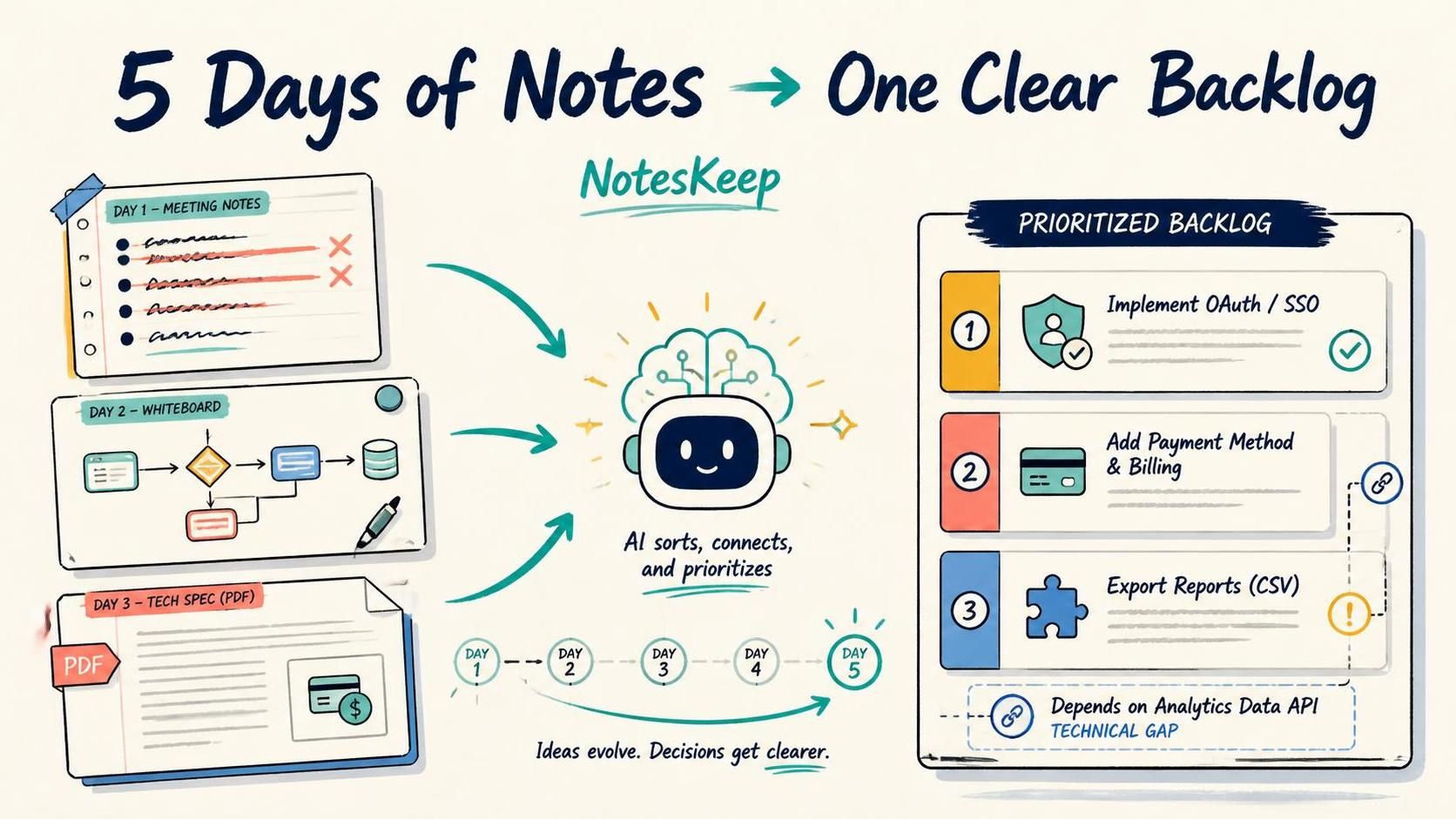
Product discovery is rarely a single, static event. Over days or weeks of stakeholder alignment, requirements evolve rapidly: earlier assumptions are overridden by later business constraints, and ideas are scattered across daily meeting logs, uploaded technical specifications, and hand-drawn whiteboard sketches.
Manually sifting through multi-day meeting histories to identify current ground truth and map technical dependencies takes hours of administrative effort. This case study demonstrates how Visual Paradigm NotesKeep and the Visual Paradigm AI Chatbot automatically perform temporal reconciliation, process multimodal visual data, and generate a prioritized, dependency-aware product backlog.
The Challenge: Managing Changing Scope Across Multimodal Inputs
Sarah, a Lead Product Manager, was charged with defining the scope for a new B2B Customer Portal. Over a five-day discovery sprint, requirement inputs arrived across multiple channels and formats:
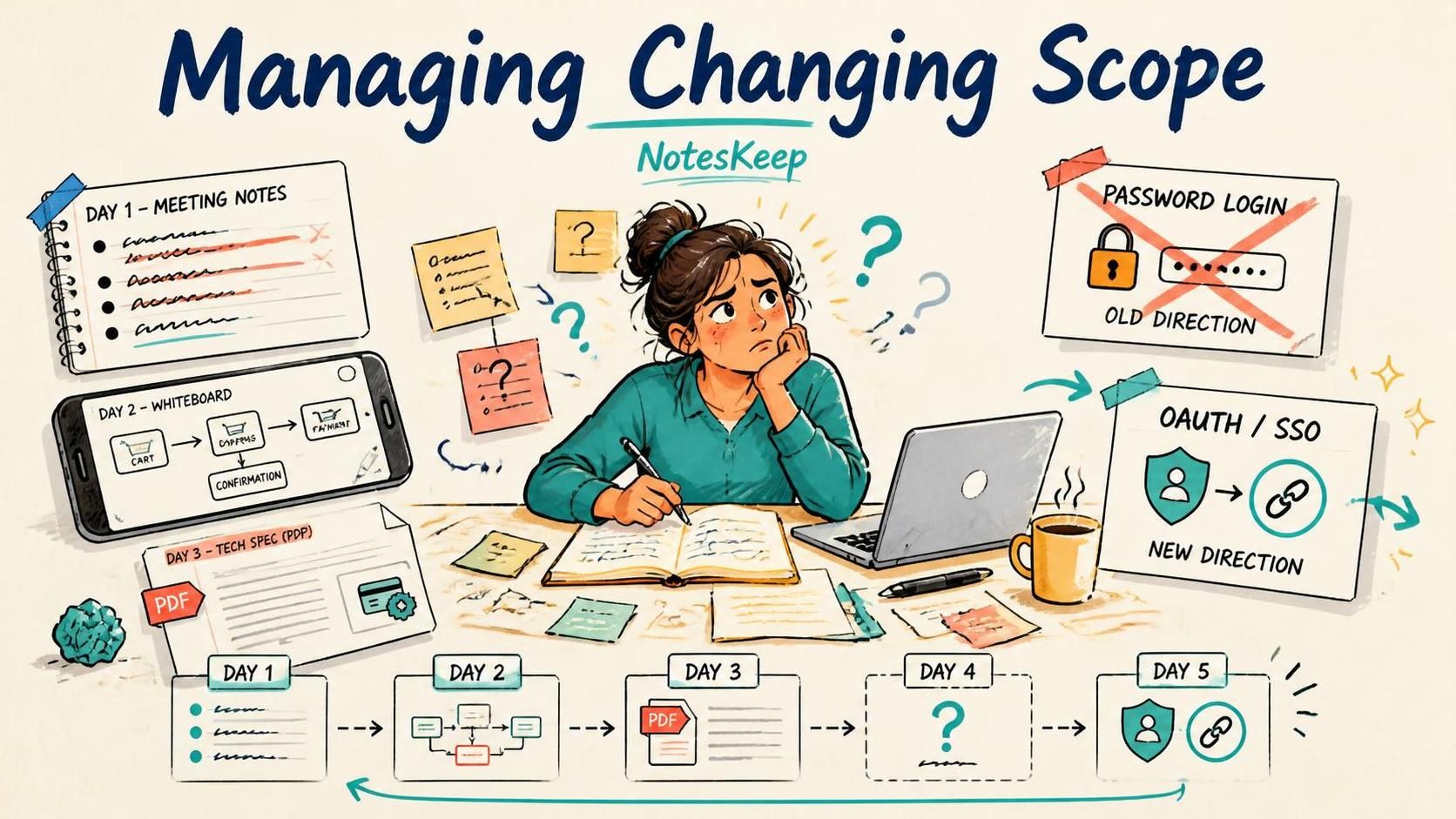
- Day 1 (Initial Requirements Note): Early discussions established basic portal features, including a custom password registration flow and billing view.
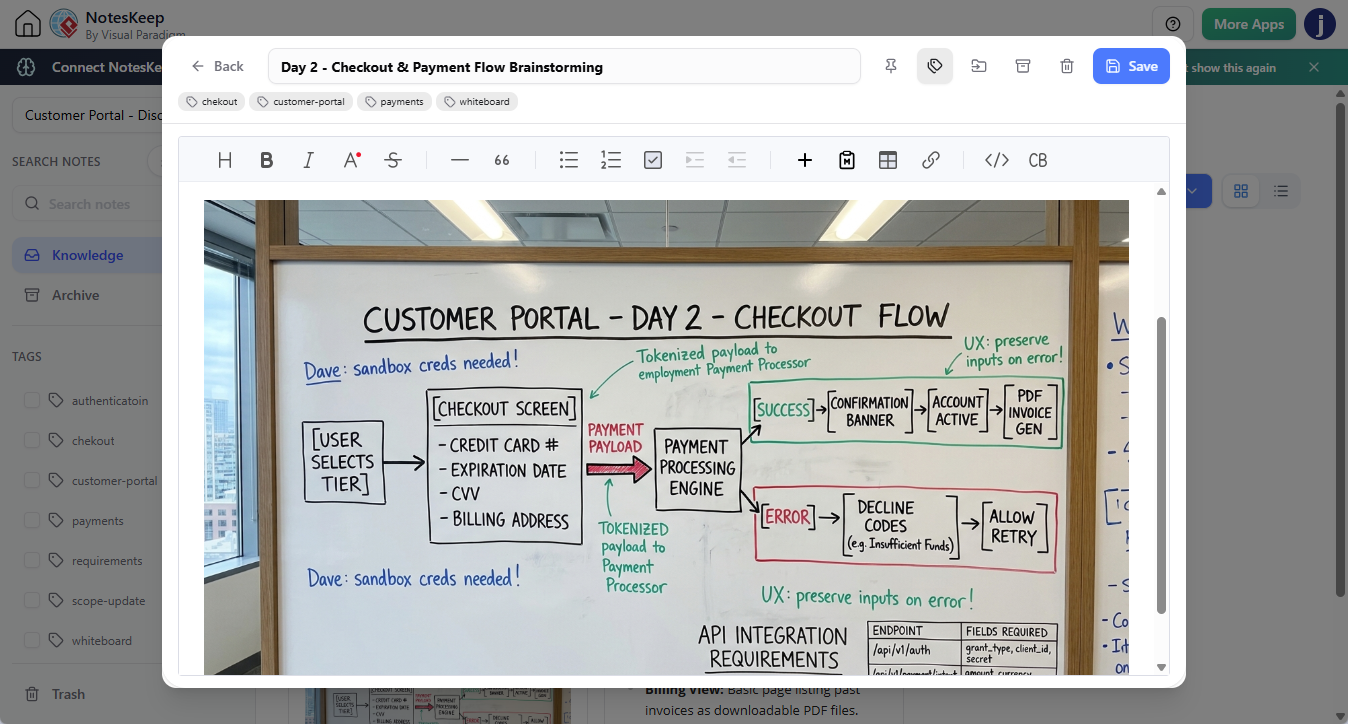
- Day 2 (Brainstorming Session Photo): The team sketched out payment processing flows and user journeys on an office whiteboard, captured as a smartphone photo.
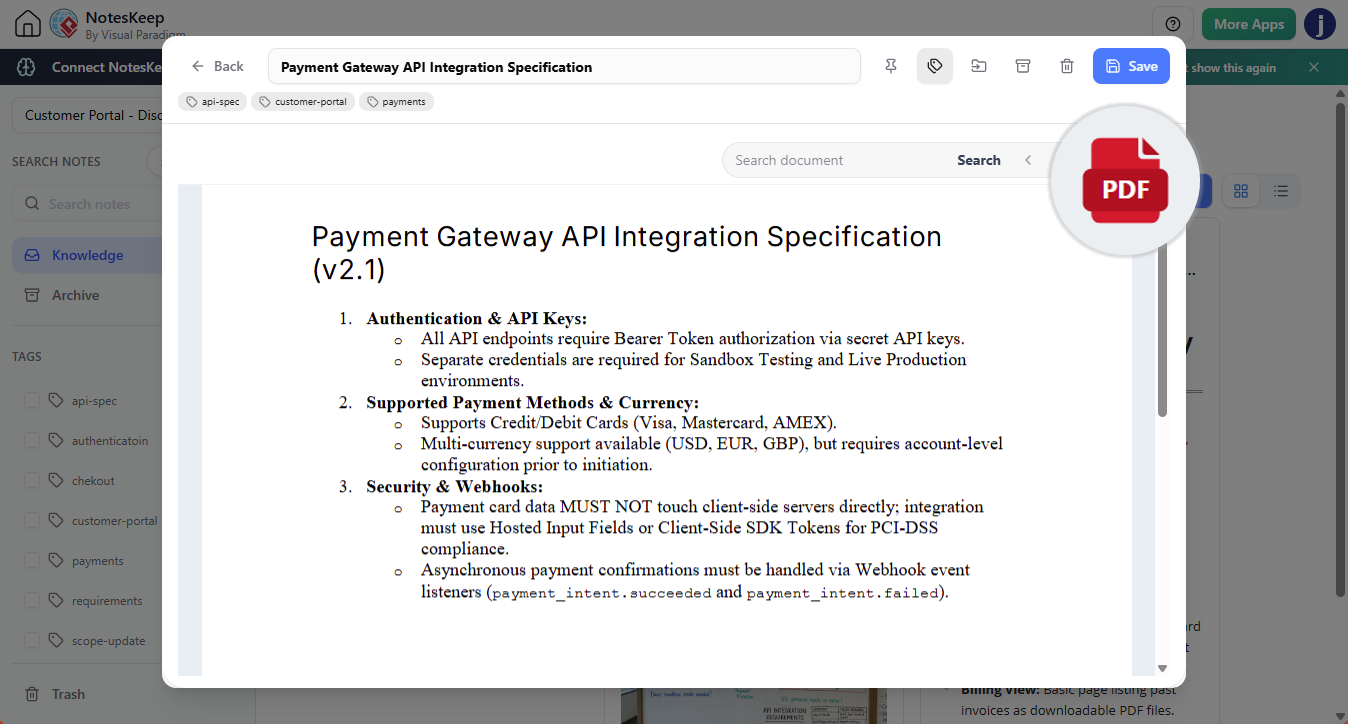
- Day 3 (Technical Integration Doc): A third-party payment gateway specification PDF was uploaded to define checkout requirements.
- Day 5 (Executive Direction Note): A late-stage alignment meeting resulted in an urgent scope change: cancel custom password authentication and replace it entirely with OAuth 2.0 / Single Sign-On (SSO) to accelerate launch.
Faced with contradictory historical notes and scattered visual assets, Sarah needed to synthesize the final active requirements without accidentally building revoked features.
Phase 1: Ingesting Multimodal Assets into NotesKeep
Sarah created a centralized project workspace in NotesKeep titled Customer Portal - Discovery Sprint. She gathered all discovery artifacts into one single source of truth:
- WYSIWYG Rich Text Notes: Logged raw notes from daily standups and stakeholder syncs, tagged with
#customer-portal,#scope-update, and#authentication.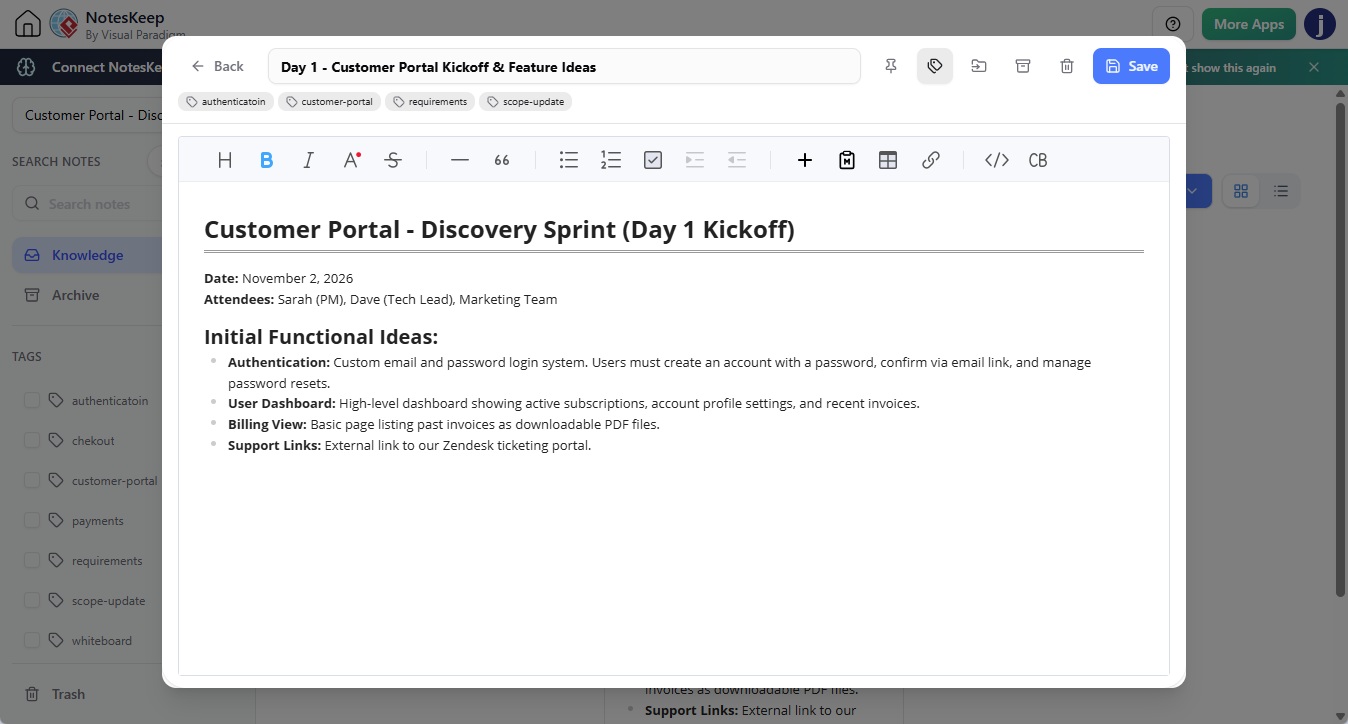
- Multimodal Image OCR Ingestion: Uploaded the Day 2 whiteboard photo directly into a note. NotesKeep’s integrated computer vision and OCR engine automatically parsed the diagram’s text labels, shapes, and operational flow arrows.
- Multi-Format Document Management: Uploaded the payment gateway’s technical `.pdf` specification into the same space for unified vector search indexing.
Phase 2: AI Synthesis, Temporal Override & Automated Gap Detection
Sarah opened the Visual Paradigm Chatbot, enabled “Search in NotesKeep”, and scoped the AI’s intelligence engine to the Customer Portal - Discovery Sprint project space.
1. Temporal Reconciliation & Active Ground Truth Extraction
To eliminate outdated decisions and synthesize all inputs, Sarah issued the following prompt:
“Consolidate all notes, uploaded specs, and whiteboard images in this project into a unified functional requirement list. Ensure that any superseded or revoked decisions are replaced with our latest active ground truth.”
The AI Chatbot performed a deep temporal and multimodal cross-examination, outputting a structured, developer-ready specification with explicit source citations:
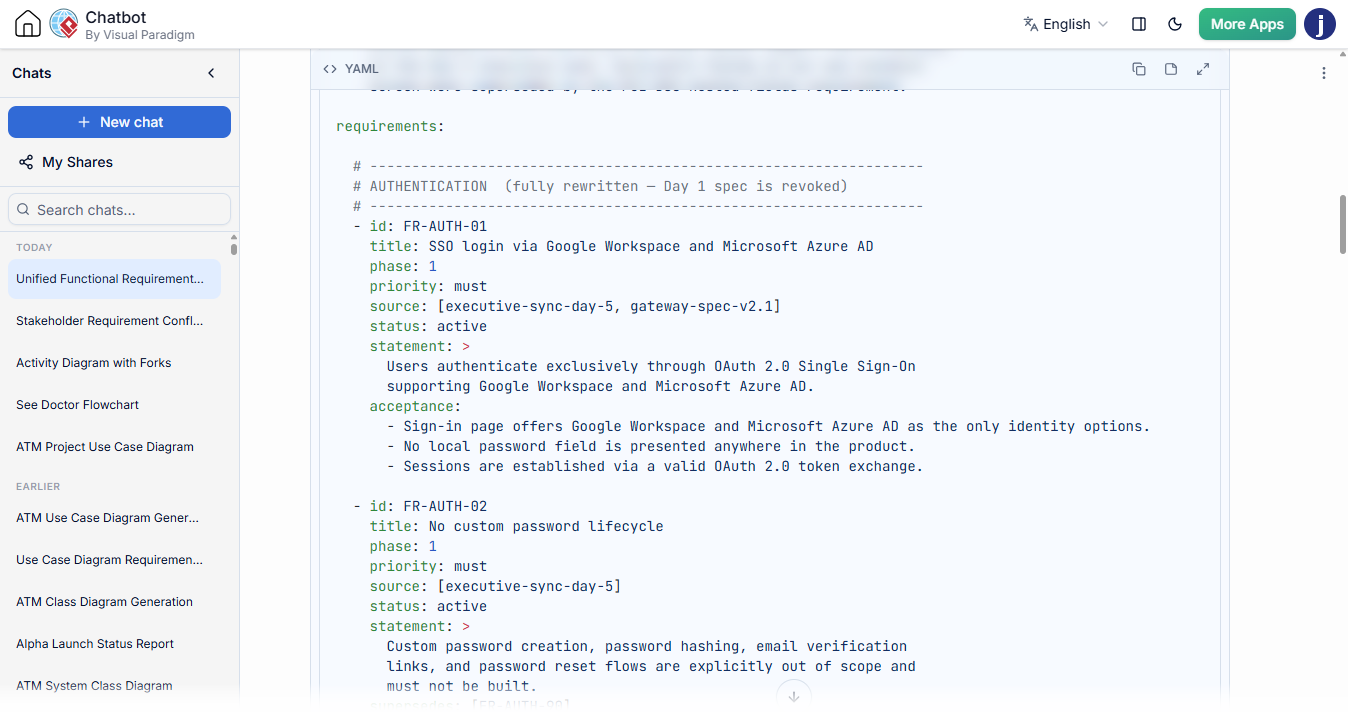
- Automatic Scope Override: The AI detected that Day 5’s executive update explicitly superseded Day 1’s “Custom Password Login.” It automatically purged password reset journeys and flagged OAuth 2.0 / SSO as the active requirement.
- Multimodal OCR Precision: NotesKeep’s computer vision engine extracted technical details directly from the Day 2 whiteboard photo—including checkout error states, decline code handling, and tokenized payment flows.
- Traceable Audit Trail: Every requirement was assigned a unique ID (e.g.,
FR-AUTH-01,FR-PAY-02) and tagged withsuperseded_byindicators so team members never re-debate cancelled features.
2. Uncovering Hidden Technical Dependencies
During the consolidation, the AI Chatbot performed a proactive gap check and surfaced a critical engineering dependency that human readers had missed:
Proactive AI Alert: “The Day 2 whiteboard’s handwritten API endpoint section references request body fields for authentication and payment intents, but no written contract exists in the notes. Action item: Obtain the exact endpoint field matrix from the technical lead.”
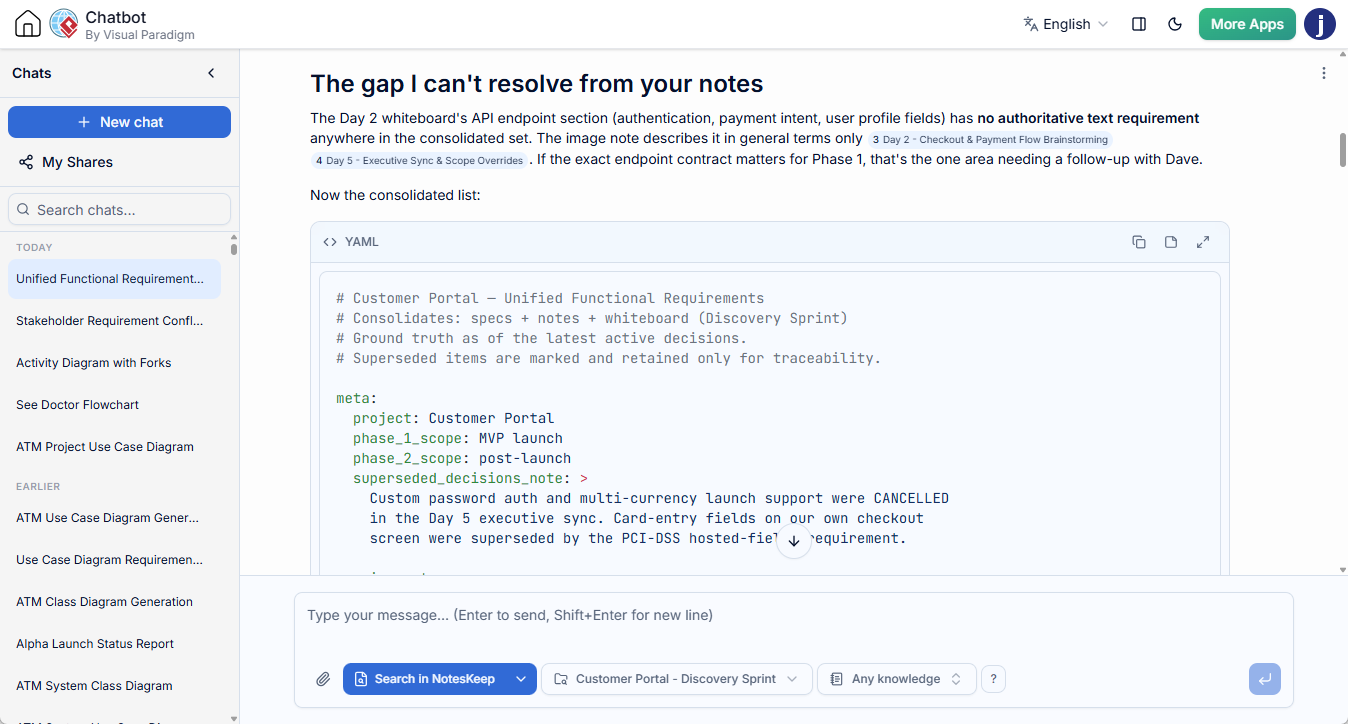
By scanning handwritten diagrams against text notes, the AI identified a missing technical contract before sprint planning, saving the development team from building against an incomplete spec.
Phase 3: The “Derive & Keep” Knowledge Loop
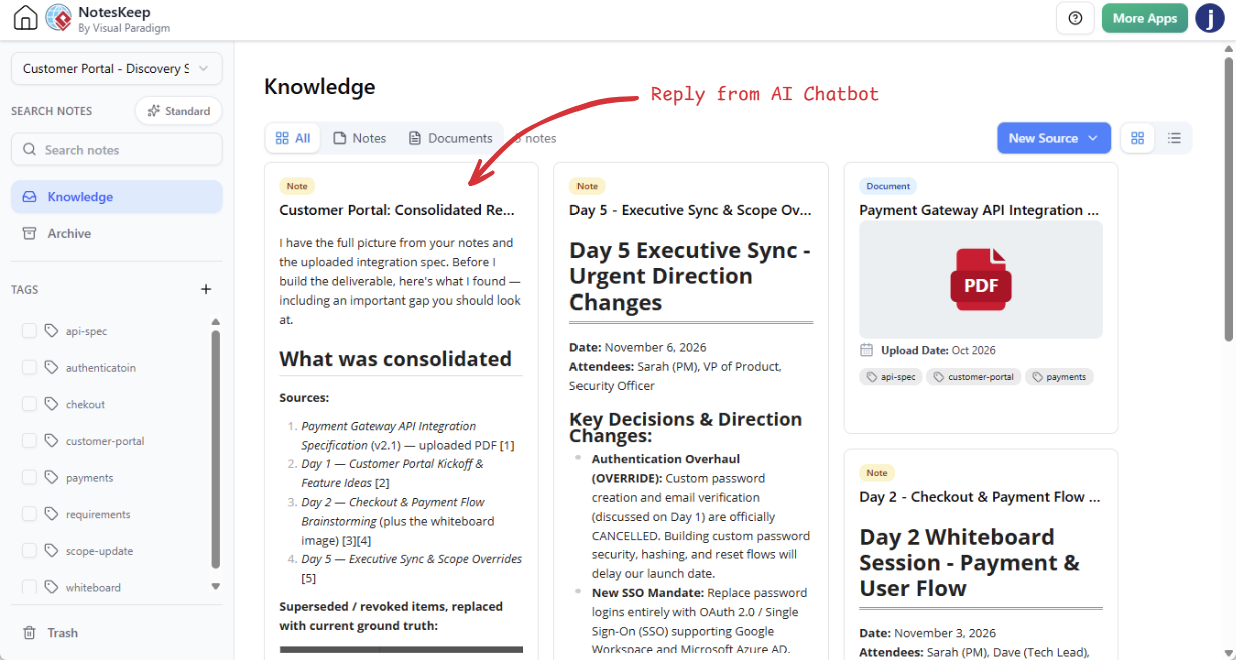
Satisfied with the AI’s analysis, Sarah clicked “Send to NotesKeep” directly from the Chatbot interface. The prioritized backlog—complete with Phase 1/Phase 2 breakdowns, dependency warnings, and inline source citations—was immediately committed back to NotesKeep as an active note titled Customer Portal: Consolidated Requirements, Revocations, and Open Gaps.
Key Takeaways & Business Benefits
- Eliminated Manual Re-Work: Reduced 4–6 hours of manual synthesis and cross-referencing to a single 30-second AI query.
- Guaranteed Ground Truth: Temporal AI reasoning prevented developers from building outdated features revoked earlier in the discovery process.
- Seamless Multimodal Processing: Converted hand-drawn whiteboard brainstorming ideas into actionable technical user stories.
- Risk-Aware Planning: Uncovered hidden technical dependencies prior to sprint planning and backlog refinement.